How Iran endured
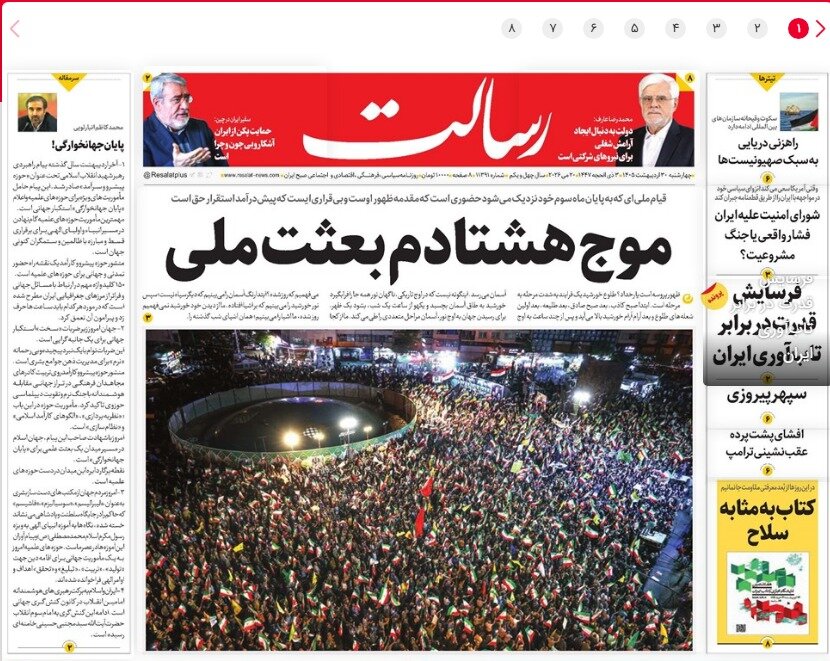
Resalat examined why Iran has endured in the current war and under Trump’s naval blockade. Iran demonstrated in this war that even under security and military pressure, it can use its economic capacities as instruments of power.
The rise in global oil prices and uncertainty in the energy market increased Iran’s oil revenues. This showed that in an energy‑dependent global economy, even a sanctioned country can shift part of the crisis pressure onto the global market. Despite the US naval blockade, rail and road routes were activated, effectively creating new channels for Iranian trade. The use of the yuan in oil transactions increased, non‑dollar mechanisms expanded, and the North–South trade corridor became more active. These developments showed that sanctions, in times of crisis, do not necessarily mean a complete shutdown of trade.
Etemad: Iran’s war; a turning point or a catalyst for a new world order?!
In an article on the emerging global order, Etemad wrote: The vulnerability of the Persian Gulf states to Iranian attacks, along with their history of entering negotiation tracks with Tehran, could lead to a scenario troubling for Israel and the United States: the formation of a regional order in which Iran emerges as a new economic hegemon and, alongside China and Russia, establishes a kind of security‑economic guarantee mechanism for the Persian Gulf region—an order that directly redefines the traditional architecture of power in the Middle East. If the war ends in the near future, Iran will likely be presented as the victorious side, and the international order will reorganize itself accordingly.
Arman‑e-Melli: Trump’s three‑part strategy toward Iran
In an interview with international affairs analyst Ali‑Asghar Zargar, Arman‑e-Melli examined Trump’s three‑part strategy toward Iran. Since taking office, Trump has pursued a three‑pronged policy. The first is information dissemination and the use of mass communication—he skillfully uses media to announce his policies and spread his lies. The second is the military threat against Iran. The third approach is negotiation diplomacy. Through these three channels, he seeks to achieve his goals. He says he wants a good deal with Iran and claims Iranians are willing to negotiate with him. At the same time, he strengthens the military posture of his forces day by day. He uses the media to create psychological pressure. The opposing side must remain alert and assess how far it can counter and neutralize this psychological warfare. Ultimately, the situation depends on how much resilience and endurance Iran’s military and society can maintain.
Jam‑e-Jam: Four possible paths for Iran’s post‑war economy
A ceasefire should be seen as an opportunity for fresh decision‑making, not merely the end of a period of tension. After the start of the third imposed war, Iran’s economy moved from the direct shock of war to emergency management and then to a ceasefire phase. But it remains far from predictability, investment, stability, and trust. In the coming months, Iran’s economy will move along one of four paths: limited stabilization, prolonged suspension, renewed tension, or a transition to conditional economic peace. The desirable path is the fourth—but it will not materialize automatically or through political declarations alone. If the ceasefire is transformed into economic rule‑making, fiscal discipline, targeted support, and the rebuilding of public trust, it can mark the beginning of a new era for Iran’s economy—one in which the goal is not merely to survive the war, but to build an economy that is predictable, resilient, and ready for reconstruction.
Leave a Comment